Venmo OSINT Tool

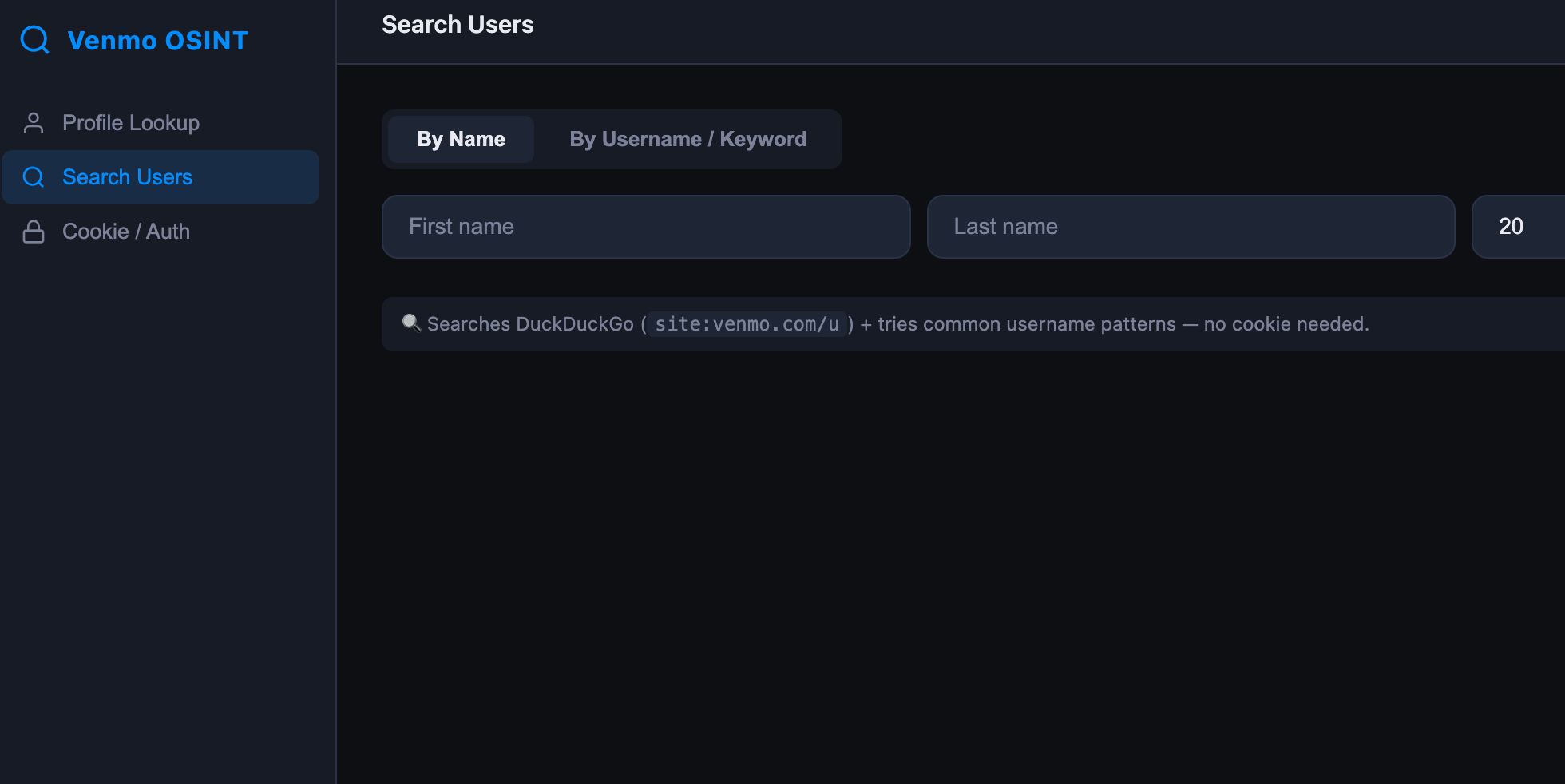
I was thinking about a way to more efficiently search for Venmo users during my investigations. I decided to use Claude to help me create something that I feel is useful.
Venmo OSINT Tool —> Github
There are two ways to use this tool:
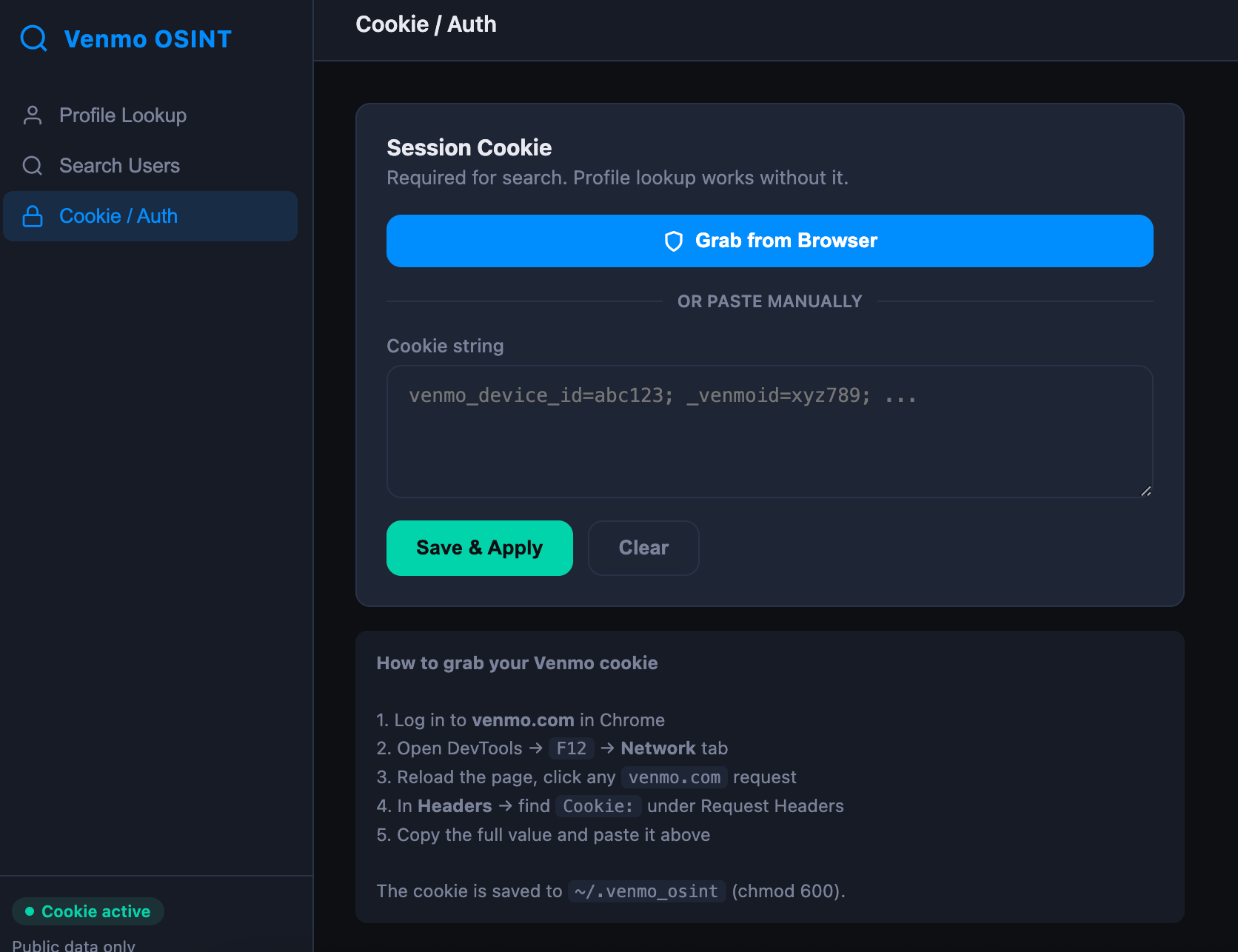
Web Version- This is the fastest way to use the tool. By default, you will start out as if you were searching the Venmo website as a logged out user. There is a built-in feature that allows you to insert your session cookie for Venmo if you have recently logged in.
Local Version- This allows you to clone the repo from Github and run it locally at http://127.0.0.1:5050/ By using the tool this way, you can simply click the button, "Grab from Browser" to allow the tool to import the session cookie for you.
I have outlined the benefits, as well as the limitations of this tool.
Benefits for Analysts
- Identity correlation — links a name to real Venmo usernames, profile photos, and account IDs, helping confirm whether a subject of interest has a presence on the platform
- No login required for basics — profile lookups work without any credentials, lowering the barrier for quick checks
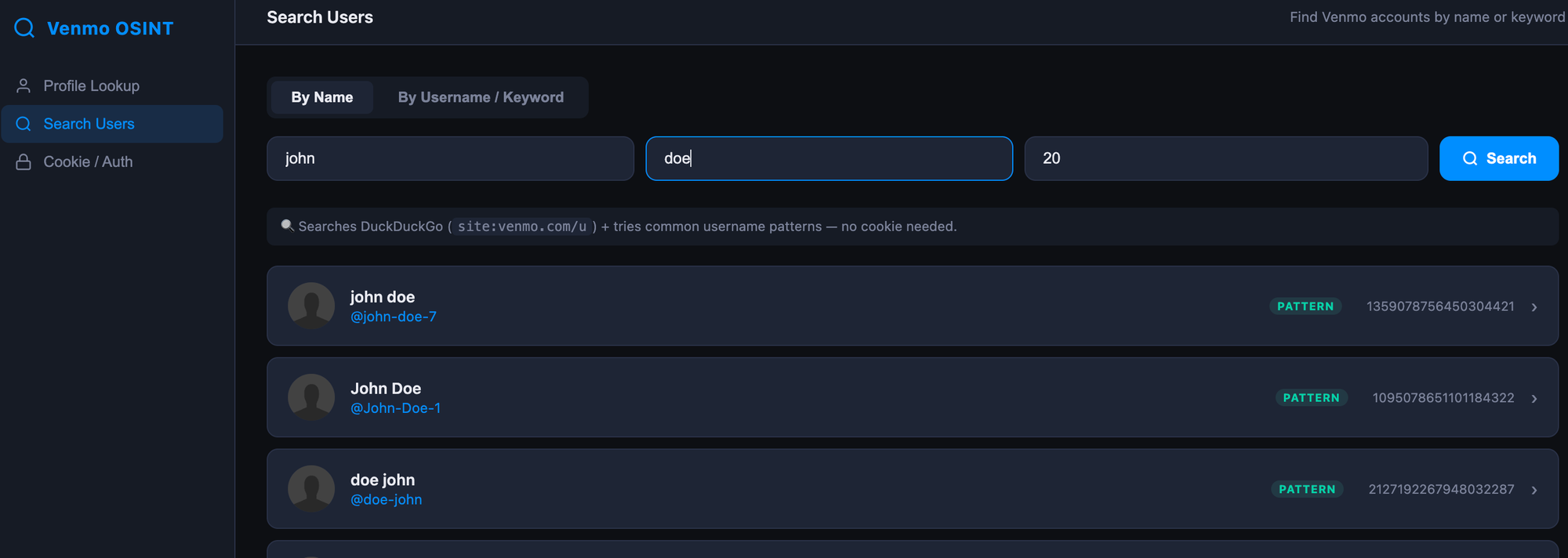
- Name-based discovery — given just a first/last name, automatically generates and tests likely usernames (including Venmo's auto-numbered formats like
Chris-Keefe-10), surfacing accounts that wouldn't be found by simple guessing - Public transaction visibility — surfaces recent public payments (who paid whom, for what, with notes), which can reveal social connections, associates, or relationships not otherwise documented
- Profile metadata enrichment — pulls first/last name, account creation date, account type (personal vs. business), active status, and bio — useful for building a subject profile or timeline
- Cross-referencing — profile photos and display names can be compared against other platforms (social media, etc.) to corroborate identity
- Export for casework — one-click export to JSON/TXT/CSV/PDF means findings can be dropped directly into reports, spreadsheets, or case management tools without manual transcription
- Optional cookie support — analysts with a Venmo account can add a session cookie to unlock deeper search results when needed, without it being mandatory
- Self-hosted / local-first — runs entirely on the analyst's machine (or their own private deployment), so search activity isn't routed through a third-party service
- Time savings — automates a process (manually guessing usernames, checking pages one by one) that would otherwise take significant manual effort per subject
- Low technical barrier — the web GUI requires no command-line knowledge; analysts can run lookups through a simple browser interface
Limitations of the Venmo OSINT Tool
- No private profile access — if a user has set their Venmo activity to private, this tool cannot bypass that; it only sees what Venmo already exposes publicly
- No guarantee of identity match — a username pattern hit (e.g.,
johnsmith) doesn't confirm it's the John Smith you're looking for; false positives are likely with common names - Name search is probabilistic, not exhaustive — it guesses likely usernames and checks DuckDuckGo's index; if someone uses an unrelated/random username, the tool will not find them
- No phone number or email lookup — cannot search by phone number, email address, or any identifier other than name/username (Venmo's public search doesn't expose this)
- No historical data — only shows the current state of a profile and recent visible transactions; cannot retrieve deleted posts, past usernames, or older transaction history
- Dependent on Venmo's UI/API staying stable — if Venmo changes its API responses, page structure, or blocks scraping further, the tool can break until updated
- Rate limiting / IP blocking — aggressive searching can get the user's IP throttled or temporarily blocked by Venmo, halting all lookups (including legitimate ones) for a period
- Cookie grab requires local browser access — the "Grab from Browser" convenience feature only works when run locally and only if the analyst is logged into Venmo themselves; it cannot extract a target's session
- No geolocation data — Venmo doesn't expose location info via these endpoints, so the tool cannot provide addresses, coordinates, or check-ins
- No notification/alerting — it's a point-in-time lookup tool, not a monitoring system; it won't alert analysts to new transactions or profile changes over time
- Legal/ethical boundary, not a bypass tool — it's explicitly limited to public data; it provides no mechanism for accessing account details, balances, linked bank info, or anything requiring authentication as the target
- Display name ≠ legal name — Venmo display names are user-chosen and can be inaccurate, outdated, or intentionally misleading
- No bulk/batch processing UI — the GUI is built for one-at-a-time or single name searches; large-scale list processing would require CLI scripting
If you have any thoughts or feedback, please let me know. I am always open to constructive criticism.